About This Carved Stone
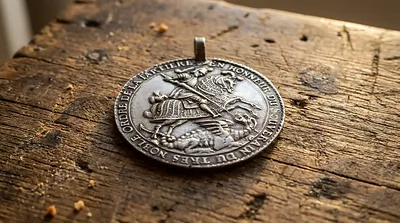
A flat slab of trap rock approximately two and a half feet long by two feet broad, bearing the date 1606 and the Masonic square and compasses carved into its natural surface. Discovered in 1827 on the peninsula extending from the Granville shore opposite Goat Island in the Annapolis Basin - the site of the original French settlement at Port Royal established by Champlain and De Monts.
The stone was first documented by Judge Thomas Chandler Haliburton, who described the inscription as deeply cut in large Arabic figures, though weathered by more than two centuries of exposure. Dr. Charles T. Jackson of Harvard independently confirmed the find, describing it as a gravestone partly covered with sand on the shore.
The prevailing theory, supported by Haliburton and later scholars including Hon. A. W. Savary, identifies it as a gravestone marking the burial of a French artisan who died on or around November 14, 1606 - a colonist fatally wounded by Indians near Cape Cod and buried upon the expedition's return to Port Royal. The square and compasses were a common trade emblem of French craft guilds and the Compagnonnage, used by masons, carpenters, and stone cutters - all trades documented among the Port Royal colonists by Lescarbot.
The stone passed from Haliburton to his son Robert Grant Haliburton, then in 1868 was loaned to the Royal Canadian Institute in Toronto via Sir Sandford Fleming. It was exhibited there until 1876, when during construction of a new building a workman inadvertently mortared it into a wall. Despite Sir Sandford Fleming offering a $1,000 reward, the stone has never been recovered. The building, now 58 Richmond Street East in Toronto, has been searched multiple times without success.
The stone represents the earliest known trace of craft guild symbolism in North America, predating documented Freemasonry in Canada by over a century.
Historical Context
Reginald V. Harris, P.G.M., "The Masonic Stone of Port Royal 1606," published by the Grand Lodge of Nova Scotia, 1950. Via skirret.com.
Where It Was Found
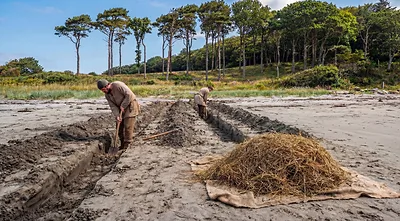
Found at Granville shore opposite Goat Island, Annapolis Basin, Nova Scotia.