Rick Lagina presents metal detection expert Gary Drayton's latest find to the team and archaeologist Laird Niven: a metal object resembling a crossbow bolt, discovered roughly ten inches below the surface on the Lot 26 beachfront by Gary, Jack Begley, and geophysicist Mike West. Laird notes the artifact is finely made with hardened iron showing minimal rust, qualities Gary attributes to the superior metallurgy of very old ironwork. Marty argues that if the bolt proves to be truly ancient, it may be more significant than the lead cross, since a weapon would not have been carried around as a keepsake but instead indicates activity on the island at the time it was lost. Craig Tester and Marty take the artifact to St. Mary's University in Halifax, where Dr. Christa Brosseau and colleague Dr. Xiang Yang perform scanning electron microscope analysis, confirming the metal is iron with manganese, an element used in iron production since as early as the ninth century BC.
At the Money Pit, borehole DE-6 yields a horizontal wooden beam at 93 feet followed by a three-foot void, matching the depth where seismic scanning detected a possible tunnel network. The drill continues to roughly 204 feet before striking bedrock, missing the large underground anomaly at 170 feet. A second borehole, H-7.5, is drilled in close proximity to H-8, the shaft that produced promising artifacts the previous season. Choice Drilling operator Brennan extracts core samples while geologist Terry Matheson, Craig, Charles Barkhouse, and Rick examine the spoils. At 160 feet, they recover what appears to be coconut fiber, a material historically found in the Money Pit and located more than 1,500 miles from the nearest coconut trees. At 171 feet, Terry identifies axe-cut wood with visible tool marks, found near the depth where seismic scanning revealed a 30-foot-wide chamber.
Rick shares the devastating news that his close friend, author and researcher Zena Halpern, has passed away at age 88. He reads a tribute written by researcher Rich Moats, and the team reflects on Zena's contributions, including the 14th-century Templar map of Oak Island she provided two seasons earlier. Rick and nephew Peter Fornetti travel to Zena's home on Long Island, New York, where they join her sons Davin and Jason in sorting through more than 50 years of research materials. Among the collection, Rick discovers a copy of the Cremona Document, reportedly authored by 12th-century Templar knight Ralph de Sudeley, describing the recovery of religious artifacts from the Temple Mount and a Templar voyage to the New World in 1178.
Construction of the 525-foot steel cofferdam at Smith's Cove advances as the Irving Equipment crew installs the ninth of approximately 120 steel sheet pilings. Site supervisors Scott and Michel report the project is on schedule, with sheets driven 26 feet into the ground to reach rock. Alex Lagina accompanies Marty and Craig to the St. Mary's University visit, where the SEM results on the crossbow bolt provide elemental data the team will use for further expert evaluation.
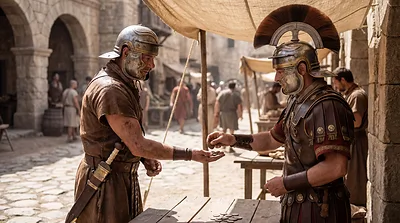
In the War Room, Doug Crowell connects the team with California antiquities expert Gabriel Vandervort, who presents his analysis of the metal object. After initially suspecting a medieval European origin, Vandervort found the artifact's long neck inconsistent with crossbow bolts and traced it further back in time. He identifies it as a Roman pilum, a type of throwing javelin carried by legionnaires from the first century BC through the fifth century AD. The thin iron neck was designed to penetrate armor and break off inside the target. Vandervort notes such artifacts are rare even in Europe and virtually unheard of in North America. Marty acknowledges the identification pushes the island's timeline back dramatically, though he remains uncertain how to reconcile a Roman weapon with the team's existing theories.