Rick and Marty Lagina, Craig Tester, Dave Blankenship, and Charles Barkhouse travel to Eagle Canada's headquarters in Calgary, Alberta, to receive the results of their seismic survey. Geophysicist Jeremy Church presents data from two key areas, beginning with the mega-bin, a site roughly 600 feet north of the Money Pit where Dan Blankenship drilled 40 exploratory boreholes in the early 1970s. The seismic imagery reveals the largest anomaly in the entire dataset: a structure approximately 50 metres long, 7 to 12 feet in height, at a depth of only 40 to 50 feet, with hard reflectors on both top and base indicating a competent structure consistent with a chamber. The result aligns with what Dan described years earlier, and Rick sees it as a chance to finally give Dan his breakthrough. Turning to the Money Pit, Church identifies a large void at 160 to 170 feet adjacent to the C-1 and H-8 boreholes, where the team previously recovered pottery, parchment, leather bookbinding, and fragments of human bone from two individuals, one European and one Middle Eastern, both over 400 years old. The void has a squared-off shape that Church says nature does not tend to produce. A network of linear features at the 100 to 110-foot range suggests a possible flood tunnel. Craig selects drill locations that could intersect both the tunnel and the deeper chamber.
Back on Oak Island, Irving Equipment begins construction of the 525-foot steel cofferdam at Smith's Cove, using a hydraulic hammer to drive approximately 120 interlocking steel sheets 25 feet into the ground. Marty explains that previous earthen cofferdams failed from seepage beneath the structures, a problem the interlocking sheet piling should solve. Meanwhile, Choice Drilling foreman Brennan arrives with a sonic rig, a system that uses high-frequency vibrations to pulverize obstacles and extract core samples from depths of up to 500 feet. Geologist Terry Matheson assists in positioning the first borehole at location DE-6, chosen based on the seismic data, where they hope to encounter both the tunnel at roughly 100 feet and a 30-foot-wide chamber near 170 feet that may contain the Chappell Vault.
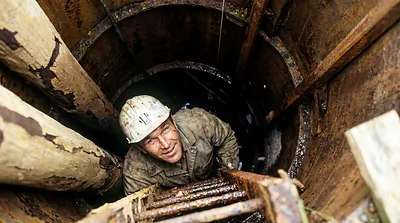
At 93 feet, the sonic drill cuts through a horizontal beam of wood, its position suggesting the top of a tunnel rather than a vertical post. Three additional feet of fragmented wood give way to solid clay, indicating the structure has collapsed. Craig confirms the find sits at the heart of the seismic anomaly, and the team plans to carbon-date the wood to determine whether it represents original construction or a later searcher tunnel. Drilling continues deeper toward the chamber below, where the Chappell Vault may have settled after being pushed downward by a 60-inch caisson the previous season.
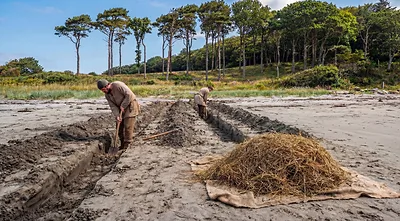
On Lot 26, property once owned by 18th-century privateer Captain James Anderson, who fled the United States after spying for the British and faced treason charges from then-Governor Thomas Jefferson, Jack Begley, metal detection expert Gary Drayton, and geophysicist Mike West survey the beach using the EM61 deep-scanning detector, capable of sensing metal up to 20 feet underground. The team recovers a square iron spike consistent with 1700s wharf construction and an iron hook of the type used for loading and unloading cargo from ships. The most striking find is what Gary identifies as a crossbow bolt, a hand-forged iron projectile he dates to between 1000 and 1500 AD, noting that crossbows were designed to pierce chain mail and fell from use after firearms emerged in the 16th century. Rick suggests having archaeologist Laird Niven or Kelly Bourassa examine the bolt to determine its cultural origin.