Rick and Alex return from a two-week research trip to Portugal alongside Doug Crowell, Peter Fornetti, author and researcher Corjan Mol, and Templar historian Joao Fiandeiro. The group visited several 12th-century Templar strongholds and later sites of the Order of Christ, where they found stone carvings matching symbols on the 90 Foot Stone and the H+O stone, a Roman road resembling the construction in the Oak Island swamp, and an Initiation Well with dimensions that mirror the original Money Pit. On Lot 15, the team reunites with Laird Niven, Steve Guptill, Billy Gerhardt, and metal detection expert Gary Drayton. Laird describes the newly uncovered stone feature as a cobble hauling path, and Rick confirms that the road they saw in Portugal is the same style of construction.
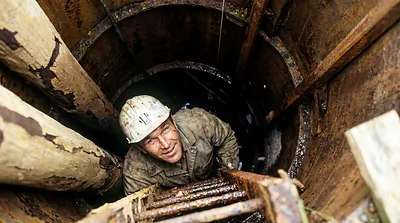
In the Money Pit, the team continues excavating B4-C, the fifth and final ten-foot shaft of the season, positioned five feet north of Borehole C1. The shaft is nearing ninety feet, the depth where pieces of wood dating to the 15th century were found earlier in the year. The hammer grab brings up a hand-hewn wooden post that Terry Matheson measures at five and a quarter inches wide, large enough to support a tunnel. Terry identifies pit saw marks on the timber, a technique dating to the 13th century. Since mechanized saws did not come into use until the 19th century, the wood likely predates the searcher era, and Rick notes that no known searcher work has been done in this area. Gary recovers iron fasteners from the spoils before the shaft reaches 131 feet, where Sam from Irving Equipment reports the material has turned significantly harder. Rick declares they have hit bedrock, and excavation of B4-C is complete.
At the research center, Carmen Legge examines an iron spike recovered from the B4-C spoils and identifies it as a rock drill used for carving out caverns and caves. Carmen notes it would have been sharpened on a swage like the one found on Lot 21 two years earlier and dates it to the 15th century. On Lot 15, Marty, Gary, and Steve search the stone path for additional clues. Marty digs out an ox shoe and questions why so many oxen would have been in the area if not for farming.
Gary Agnew, Doug Schouten, Kim Lawrence, and Max Howarth of Ideon Technologies join the team in the War Room to present muon tomography as a method for scanning the island. The technology uses sub-atomic atmospheric particles to detect mineral and metal deposits, voids, tunnels, and vaults with over 95 percent certainty, though a full scan would take six to seven months. Muon technology famously detected an unknown chamber in the Great Pyramid of Giza in 2017. On Lot 18, south of the Money Pit, the team begins preparation by drilling five boreholes near the South Shore Pit, where Dan Blankenship long believed a tunnel connected to the Money Pit. Craig Tester and Marty oversee Choice Sonic Drilling as detection devices are placed: one at the center of the Money Pit and four at the cardinal points surrounding it.
In the season's final War Room meeting, Steve reports that nearly 1,000 artifacts were recovered during the year, up from 700 the previous season. Rick says the answers lie in the swamp, and Doug Crowell calls it a time capsule, noting that the team has recovered wood dated to more than a thousand years old along with 17th-century pieces and ancient Mi'kmaw pottery from the stone path in the southeast corner. Jack Begley suggests continuing to explore Lot 4, where a magnetometer anomaly and several interesting artifacts were found, while Marty adds the stone road on Lot 15 as a priority for the future. The discussion turns to the evidence pointing to Portuguese activity on the island. Marty closes the season by stating there is gold on Oak Island and the team needs to advance the search next year.