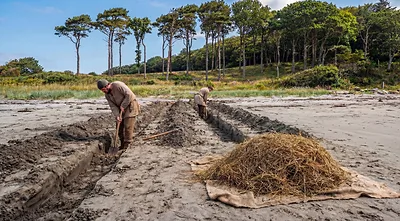
Terry Matheson and Charles Barkhouse supervise the drilling of Borehole AB13.5, positioned two and a half feet from the east side of the suspected offset chamber. Adam brings over a core from eighteen feet that reveals only solid, dense blue-gray till, with the team hoping to encounter the chamber at approximately 65 to 70 feet. Alex Lagina arrives as additional samples are examined, but neither the 18-to-28-foot range nor a sample from 77 feet shows any break or disturbance. Craig Tester orders another borehole to the north. On Lot 4, where the team recently found an adze and a gold-plated button dating to the late 17th century, Gary Drayton, David Fornetti, and Peter Fornetti begin metal detecting. After an initial signal turns out to be a tin can lid, they find a piece of metal between two rocks on the beach that Gary identifies as copper sheathing from the mid 1600s to mid 1700s. Gary explains that copper sheathing was the "duct tape" of the era, commonly used to line ship hulls against worms. Alex and David bring the piece to Carmen Legge at the research center, where Carmen says it was made using primitive rollers and shows visible impurities in the metal. He adds that it would have been used to protect a box or chest holding valuables and could date as far back as the 1100s.
Marty meets with Craig and Scott Barlow to present a new theory about Borehole AB13. Marty believes the air they encountered came from a manmade gas trap rather than the offset chamber itself, suggesting they may have hit an elevated section of a flood tunnel where air was introduced during earlier drilling programs. If they can verify the tunnel, blocking the water flow could protect the ten-foot shaft excavation. Craig and Scott agree there is time to drill one more borehole. In the swamp, Gary, Billy Gerhardt, Peter, David, and Michael John continue their search. Gary recovers irregular deck planking that joins the growing collection of wooden pieces found over recent weeks, along with a second piece of shaped wood that will be sent for evaluation. Peter discovers a piece of wood with a square hole that Gary says is marine related, noting that a square-shanked fastener would have been used before the 1700s and placing the piece in the mid 1500s to mid 1700s. Rick and Marty arrive to tell the group that swamp operations are shutting down. The ten-foot shaft dig will require thousands of gallons of water to run spoils through the wash plant, and since ocean water cannot be used, the team needs the freshwater spring in the swamp to refill.
In the War Room, the team meets with Scott Clarke, Oak Island researcher and 33rd-degree Freemason from Toronto, who presents evidence that the silver found on Oak Island may have come from Captain William Phips and his recovery of the Spanish galleon Concepcion. Built in 1620, the Concepcion was a 600-ton galleon and the premiere vessel of the Spanish fleet, tasked with carrying plundered riches back to Spain from the New World. In 1641 the ship sank during a massive hurricane off the coast of the Dominican Republic while carrying more than one hundred tons of gold and silver. Over 300 crew members perished along with the treasure. Four decades later, Phips launched a salvage mission financed by British royalty, locating the wreck in January of 1687. Using Indigenous free divers, Phips recovered more than 34 tons of treasure valued at £205,000, equivalent to roughly fifty million dollars in modern currency. Phips received £11,000 and was knighted by King James.
Scott explains that Captain Andrew Belcher became Phips' assistant and helped maintain the relationship between the American colonists and the Indigenous tribes, while also assisting Phips with further Concepcion salvage expeditions. When Phips returned to the wreck in September of 1687, he recovered only £10,000. Scott then presents a 1688 letter showing that Belcher was caught with one of Phips' ships in the Mahone Bay area and that the vessel was burnt at Port-la-bare, very close to Oak Island. Scott believes Belcher was transporting Concepcion treasure to Nova Scotia. He also shows the team a 1701 map titled "The English Empire in America," created by Herman Moll and published in 1688, which marks the location of the Concepcion shipwreck and labels an island in the position of Oak Island as La Plata, meaning "the silver."