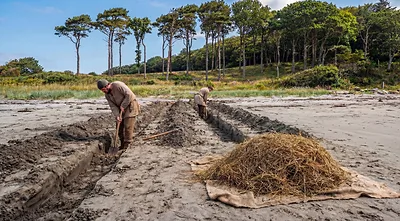
Terry Matheson, Craig Tester, and Charles Barkhouse supervise the drilling of Borehole A13, positioned two and a half feet north of AB13 where an eruption of air at approximately 68 feet last week indicated a cavity or offset chamber. The team hopes A13 will confirm the chamber and provide evidence of valuables inside it. A core from 48 feet shows loose till, consistent with proximity to an opening. At around sixty feet the material takes on a maroon tint before the drill makes a grinding sound and Mike Tedford reports that air has started escaping again. The team decides to keep drilling until they hit a hard surface. At 82 feet the bit reaches bottom, and the final sample contains dense material along with two pieces that resemble grass. The team suspects it could be eelgrass, the same material the Truro Company found in 1850 covering five stone box drains at Smith's Cove that filtered seawater feeding the flood tunnel.
On Lot 32, Gary Drayton and Michael John search for artifacts related to wharf activity. A large rock stake found there the previous week was identified by Carmen Legge as a ship anchor, and a wharf spike and lead bag seal were recovered the year before. Michael digs at the first location and uncovers a coin that Gary believes is an old British copper, similar to two 17th-century coins found on Lot 16 four years earlier. The coin will go to Kelly Bourassa for conservation. In the swamp, Gary, Peter Fornetti, David Fornetti, and Billy Gerhardt continue searching the area west of the stone wharf, where numerous artifacts over the past few years have suggested the swamp may be manmade. Peter pulls out a trapezoid-shaped piece of wood with beveled edges that Gary thinks came from inside a ship. More wood surfaces the following day, including a shaped piece that Michael says resembles an oar or paddle and another bearing concave scrape marks that Gary attributes to an adze. Rick arrives to examine the pieces and agrees to bring in marine archaeologist Dr. E. Lee Spence to evaluate the finds.
In the War Room, Dr. Spence identifies the paddle-shaped piece as likely being exactly that, pointing to three nail holes where a handle would have been attached. A larger piece, carbon dated to 1520 to 1674, he confirms could easily be part of a ship. Another piece he identifies as a fid used for splicing very heavy rope such as an anchor cable, rather than a belaying pin, and notes that fids have been in use for thousands of years. The trapezoid piece, found at a depth of ten feet, Dr. Spence says is broken and was originally nailed to another piece of wood.
Dr. Ian Spooner presents carbon dating results for two of the swamp finds. The trapezoid piece dates to 1683 to 1735, and a small piece showing evidence of rope burn dates to 1680 to 1740. Doug Crowell tells the team that he and Scott Barlow visited the Maritime Museum of the Atlantic to examine a longboat with a bulkhead, and the bulkhead's construction closely matches the trapezoid piece recovered from the swamp. Doug shows the team photographs from the museum for comparison.