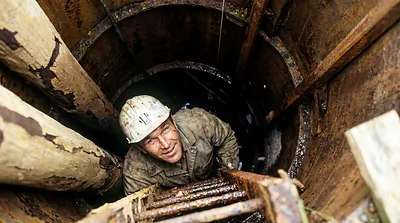
At Smith's Cove, Rick Lagina, Steve Guptill, Terry Matheson, and Charles Barkhouse oversee the team's effort to drill into targets identified on the Barringer survey, a military-grade VLF scan commissioned by Dan Blankenship and David Tobias in 1988. Borehole NF-1, targeting a nonferrous deposit between 80 and 120 feet, encounters dense clay at 79 feet before transitioning into crumbly limestone unsuitable for tunneling. A second borehole, NFM-2, is drilled 15 feet to the east to target a possible tunnel anomaly but reaches 134 feet with only a natural bedrock fracture and gypsum deposits to show for the effort. Terry concludes the geology is natural, and the team calls both holes.
Along the stone pathway near the northeastern border of the swamp, Alex Lagina, archaeologists Miriam Amirault and Dr. Aaron Taylor, and heavy equipment operator Billy Gerhardt uncover what appears to be a corner in the ancient road, suggesting it turns uphill toward the interior of the island. Metal detection expert Gary Drayton and David Fornetti join the investigation and recover a string of compelling artifacts: a military-style cuff button dated 1750 to 1850, a piece of iron identified as a possible fire grate from the nearby burn feature, a fragment of French transfer print pottery from the early 1760s, and a possible musket gunflint potentially dating to the early 1600s. Each find reinforces the case that the pathway predates the 1795 discovery of the Money Pit and was constructed by either British or French forces.
In the research center, Doug Crowell shows Marty Lagina and archaeologist Laird Niven a mysterious metal artifact he discovered in Dan Blankenship's archived files, labeled as having been found in the swamp in the 1970s. Doug and project manager Scott Barlow travel to Northville Farms in Centreville, Nova Scotia, where blacksmithing expert Carmen Legge examines the object. Carmen identifies it as part of a large cannon, noting its layered metal construction and traces of burnt gunpowder in its exhaust ports. He dates the artifact to the mid-1400s, aligning it with other pre-Columbian finds the team has recovered this season.
In the War Room, Marty, Craig Tester, and Jack Begley review the Barringer drilling results with Rick and Doug via video conference. The team acknowledges that two boreholes cannot definitively rule out the survey's targets, noting that 16 holes would be needed for full coverage, but agrees to shelve the effort and return the drill to the Money Pit area. Meanwhile, at the southern border of the swamp, Steve Guptill records depth measurements as Billy Gerhardt excavates a cross-sectional trench designed to model the ancient landscape. At approximately ten feet below sea level, Billy pulls a polished, finished piece of wood from the muck that the team identifies as a possible ship's railing. His excavator encounters a large obstruction at the bottom that prevents further digging, raising the possibility that something substantial lies buried in an area where a 200-foot-long anomaly resembling a sailing vessel was previously detected by seismic survey.