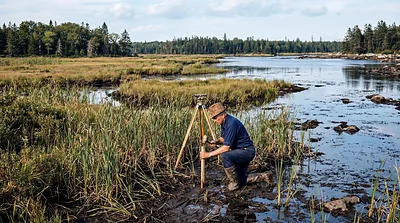
Rick Lagina shares the recently discovered iron ringbolt with Tom Nolan in the swamp, a deeply personal moment given that Tom's father Fred spent decades investigating the triangle-shaped bog. After M.R. Chappell denied him access to the Money Pit in the early 1960s, Fred Nolan purchased eight lots across the center of the island including the swamp, where he found two large ringbolts embedded in boulders on the eastern edge. When he drained the area in 1969, he recovered wooden scuppers and part of a mast from a large sailing vessel, leading to his theory that the swamp was artificially created to conceal a treasure galleon. Jack Begley, Tom, and Charles Barkhouse bring the new ringbolt to blacksmithing expert Carmen Legge at Northville Farm, approximately 50 miles north. Carmen identifies it as a wharf pin designed for timber rather than granite, with a split end that prevents it from pulling free once driven into wood. He dates the forging style to between the 1600s and 1760, well before the known discovery of the Money Pit in 1795.
In the War Room, Tom and Charles relay Carmen's findings to Rick, Marty Lagina, and Doug Crowell. The ringbolt's splayed end confirms it was driven into a structure and not merely dropped, and its recovery atop the stone pathway carries major implications. Doug reasons that if the ringbolt dates no later than 1760 and was already buried beneath accumulated soil, the stone road underneath must be considerably older, potentially by two centuries. The team theorizes that a wooden wharf once stood in what was then a sea inlet, connecting to the square rock structure detected by sonar off the south shore earlier in the season, the cribbed wharf remains diver Tony Sampson confirmed on a subsequent dive, and the 200-foot galleon-shaped seismic anomaly identified two years prior. Near the ringbolt site, Billy Gerhardt and Dr. Ian Spooner examine a piece of slate with a circular indent that does not appear natural, and Billy discovers cobblestones in a test hole confirming the road extends along the eastern swamp border and turns uphill toward the Money Pit.
On Lot 25, Marty visits archaeologists Laird Niven and Liz Michels at the former homestead of Samuel Ball, who purchased his first island lot in 1786 and by his death in 1846 owned nine lots plus mainland property. An 1870 publication, "The History of the County of Lunenburg," names Ball as one of three men who first discovered the Money Pit in 1795. With Laird and Liz supervising the heritage-protected site, Gary Drayton recovers a copper pocketknife handle consistent with a gentleman's knife and a patent plate engraved with the word "PATENT," likely from a British musket or rifle dating to the 1790s through 1830s. Both finds point to a level of wealth that raises familiar questions about the source of Ball's prosperity.
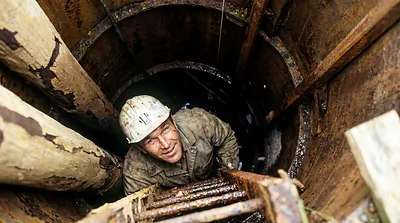
In the Money Pit area, Scott Barlow, Charles Barkhouse, geologist Terry Matheson, and surveyor Steve Guptill push borehole CD 8.5 past 100 feet, recovering hand-hewn lumber with visible axe cuts at approximately 103.5 feet along with a wall, floor, and beam. Steve believes the drill passed down the center of a shaft, and the team concludes they have likely delineated the Tupper Shaft. Doug Crowell then presents diagrams from the files of the late Dan Blankenship dating to the 1890s, which place the Money Pit to the west of the Tupper Shaft rather than to the east, where the team has been concentrating its search. The western zone includes borehole C-1, drilled five years earlier at Charles Barkhouse's suggestion, which encountered a void 20 feet deep by 10 feet wide containing three gold-colored objects visible on camera. The team unanimously decides to prioritize this western location for the next drilling program.