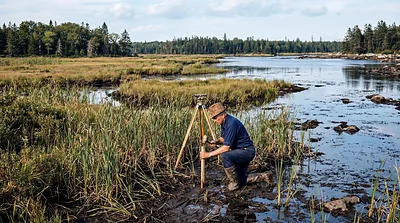
In the southeastern corner of the swamp, Rick Lagina, Tom Nolan, Scott Barlow, and archaeologist Dr. Aaron Taylor continue investigating the two massive stone pathways uncovered in the triangle-shaped bog. Aaron identifies the main feature as a road leading up to the Uplands, possibly connected to a small harbor used for unloading cargo. Beneath the road surface, the team discovers a second layer of stone supported by wood cribbing and cut stakes driven into the swamp floor. Chunks of coal and charcoal also appear among the stones, suggesting a burn event and lending further support to Fred Nolan's long-held theory that a treasure galleon was sailed between what were once two separate islands, unloaded, and burned in a man-made swamp. Later, Dr. Ian Spooner and Rick uncover layers of hand-cut wood that served as a foundation for the stone road. Woodchips from axe work are scattered everywhere, confirming the road required significant engineering, multiple workers, and a deliberate cribbing system to distribute weight across the boggy ground.
In the War Room, Dr. Christa Brosseau, a professor of chemistry at Saint Mary's University in Halifax, presents her analysis of a square nail recovered from borehole C-9 at a depth of 95 feet. The nail contains 0.68% manganese, placing it firmly in the post-1840 range for wrought iron. This finding is consistent with the Tupper Shaft, constructed in 1850 by Adams Tupper of the Truro Company just ten feet northwest of the original Money Pit. Craig Tester, Marty Lagina, and Jack Begley then meet in the War Room to discuss next steps. To confirm they have located the Tupper Shaft, they plan to drill borehole CD 8.5 to define the structure's dimensions and depth. Cores from that hole reveal wood at 18, 24, and 28 feet, along with a significant intersection of stacked timber that geologist Terry Matheson and surveyor Steve Guptill believe could be a shaft wall.
Doug Crowell and Scott Barlow travel to Northville Farm in Centreville, Nova Scotia, to consult blacksmith expert Carmen Legge about a large iron artifact recovered from Lot 13 near the eastern edge of the swamp. Carmen identifies it as a double-bolted latch from a high-end security lock, designed for a heavy chest or trunk rather than a simple traveler's bag. The piece connects to a gold-colored knob that rare coin expert Sandy Campbell previously suggested may have come from a jewel chest.
On Lot 25, Marty and Alex Lagina visit archaeologist Laird Niven and Liz Michels at the former homestead of Samuel Ball, where a special heritage permit allows excavation of the protected site. The team has uncovered a stone-lined pit containing organics, handwrought nails, and a surprising variety of pottery including redware with a tortoiseshell design dating to the late 18th or early 19th century. Nearby on the eastern Uplands, Gary Drayton and Billy Gerhardt make a striking find: a large hand-forged iron ringbolt that may be one of three ringbolts Fred Nolan discovered in the 1960s, which he believed were used to anchor a treasure ship on the edge of the swamp. Laird confirms the piece is old, placing it comfortably in the 18th century.