Geophysicist and sonar expert Brian Abbott returns to Oak Island to conduct a new scan of the chamber at the bottom of Borehole 10-X, the 235-foot shaft northeast of the Money Pit. In 2014, Abbott's previous scan identified several targets in the chamber, including one he assessed at 90 percent confidence as a man-made chest roughly two and a half feet by two feet. However, when John Chatterton explored the cavern last season, he found a square angular rock in the same position, picked it up, and moved it, concluding it was the source of the sonar signal. Today's rescan is designed to settle the question: if the target has shifted, Chatterton's account is confirmed. Abbott deploys the same MS 1000 scanning sonar device and reports that the cavern walls and tunnel-like openings look unchanged, but the square target is gone. The chest-shaped object has disappeared from the data, consistent with Chatterton having moved a rock rather than missing a man-made artifact.
In the War Room, the results trigger a sharp debate. Marty considers 10-X explored and wants to move on. Rick, Dave Blankenship, and Dan Blankenship push back. Dave reminds the group that chain, wire, and low-carbon steel, all tested as pre-1750, were recovered from the bottom of 10-X, and he reveals he made a promise to his mother to try and finish what Dan started. Rick argues that what Dan saw during his original camera observations decades ago could now be buried under accumulated silt. Marty ultimately concedes that costing out a potential bottom-of-hole excavation would cost nothing, and the team agrees to shelve 10-X for now while continuing to explore the option.
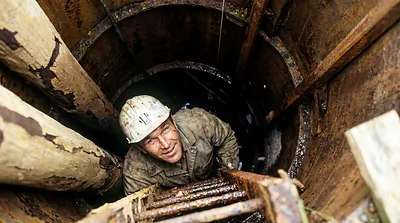
Attention shifts back to the Money Pit. Sonar experts Blaine Carr and Evan Downie deploy a BlueView scanning sonar device into the C-1 shaft, lowering the unit on a tripod to the bottom of the cavity at roughly 190 feet. Unlike previous sonar equipment used on the island, the BlueView pans and tilts while scanning, producing higher-resolution 360-degree 3D images. John Chatterton and safety diver Howard Ehrenberg observe the operation as part of their dive preparation. Rick, Charles Barkhouse, and the team watch as the BlueView data reveals the void extends in multiple directions, with at least one passageway measuring roughly 37 to 40 inches in diameter. Chatterton then makes the first-ever human descent into C-1, navigating through the steel caisson and entering the cavity. He reports the walls have a rough, chipped texture with sharp edges rather than the smooth surfaces typical of natural solution cavities, a feature he considers possible evidence of man-made carving. The ceiling is solid and stable, and he sees no signs of imminent collapse.
After Chatterton surfaces and his body stabilizes, dive supervisor Mike Huntley makes a second descent carrying an underwater metal detector. Despite near-zero visibility caused by heavy silt on the cavity floor, Huntley gets multiple metal detector hits in the rubble at the bottom. After confirming the readings are not false signals from his stainless steel helmet, he reports at least two distinct metallic targets roughly two feet apart. The presence of metal in what should be a natural bedrock void is significant, as Craig Tester notes there should be no metal in a solution feature, meaning any confirmed metallic objects would point strongly toward human activity at this depth.