With Valley 3 now confirmed as Mel Chappell's 1930s searcher tunnel rather than the Chappell Vault, the team shifts its full attention to Borehole C-1, located 20 feet northwest. The massive steel caissons continue grinding toward the 21-foot-deep void detected at approximately 171 feet, where last season Rick Lagina and Charles Barkhouse spotted a shiny gold-coloured object on an underground camera. Progress through the upper soil is faster than expected, with the caisson reaching 85 feet early in the episode and large granite boulders coming up in the hammer grab. Charles estimates bedrock at around 150 feet, where the team will need to anchor the 60-ton caisson stack before switching to a 39-inch drill bit to cut through the ceiling of the cavity. Andrew from Irving Equipment agrees to an unusual procedure: lowering the hammer grab well beyond the bottom of the shaft once breakthrough occurs, so that any material that collapses from the ceiling, including the gold object, can be retrieved from the chamber floor.
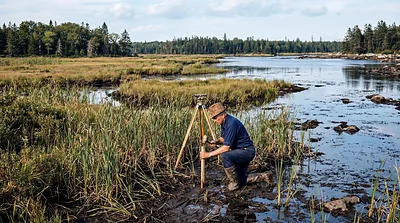
Rick and Marty begin draining the triangular swamp, now possible under the agreement reached with Fred Nolan before his death. A 63-horsepower dry-prime pump and more than 1,200 feet of hose transfer thousands of gallons of brackish water to the Cave-in Pit near Smith's Cove. Environmental regulations require organic material such as peat and liquid mud to be separated from inorganic clay and rock, with everything returned in the same order once excavation is complete. With the swamp roughly 90 percent dry, Jack Begley and Alex Lagina begin digging at the EM-61 target site. A handheld metal detector gives inconsistent readings, suggesting the object may be buried deeper than a foot. At the Fo'c'sle Tavern, Rick, Marty, Craig Tester, and the team review the day's findings. Jack describes a spike recovered by Gary Drayton from the north end of the swamp, which Gary identifies as a deck fastener from a Spanish galleon, distinct from a railroad spike because of its shorter length and lack of a secondary grip point. The find comes from the north end of the swamp, adding to theories that a ship may have been deliberately sunk there centuries ago.
Charles Barkhouse and investigative journalist Randall Sullivan travel to the South Shore Genealogical Society in Lunenburg, roughly 20 miles southwest of Oak Island. Archivist Stephen Ernst produces an 1883 A.F. Church Company map of the area that labels Oak Island properties by household name and includes a handwritten notation reading "Kidd's Treasure," a direct reference to the 17th-century pirate Captain William Kidd, who was hanged in 1701 after offering to trade his life for a mysterious treasure he claimed was buried somewhere east of Boston. The map also identifies the McGinnis family, one of the founding families connected to the 1795 Money Pit discovery, as property owners on the island.
At the Money Pit, the C-1 drill bit reaches its target depth and breaks through the ceiling of the void. The bit drops several inches as it punches into softer material, confirming entry into the cavity. Andrew reports a clear, unobstructed hole all the way through. Rick and Charles stand at the top of the shaft knowing that the gold-coloured object, along with whatever else the ceiling collapse dislodged, now rests on the chamber floor roughly 192 feet below. The team prepares to send down a camera, sonar equipment, and potentially a diver in the episodes ahead.