The GAL-1 shaft, named after Rick and Marty's parents George and Ann Lagina, is the team's fourth and final exploration hole of the season. Positioned seven feet south and four feet west of the Valley 3 bottom hole based on drilling consultant Greg Dwyer's debris-field analysis, the shaft is designed to intersect the scatter zone created when the Money Pit collapsed toward Shaft Number Six in 1861. As the caisson passes 130 feet, hand-hewn wood and fragments of old timber begin appearing in the hammer grab, along with 20-foot layers of clay followed by more wood. At approximately 150 feet, the spoils begin yielding chunks of very dark wood coated in what appears to be pine tar, a substance used for centuries as a waterproof sealant to protect the contents of wooden structures. The wood differs significantly from the lighter timbers recovered above, and Craig Tester observes that the depth matches the top of the area where Chappell and Blair reported finding a seven-foot-tall wooden vault in 1897.
Gary Drayton and Jack Begley search the GAL-1 spoils with a metal detector and recover several significant finds. A gold-plated object, initially thought to be a coin, is identified as an 18th-century British military officer's button, further supporting the theory of a pre-1795 British military presence on the island. Gary also recovers a hammered iron object with a square nail hole punched through it, consistent with pre-1800 hand-forged hardware, and what appears to be a sailcloth needle, a double-ended iron tool used aboard sailing vessels to sew canvas sails. Gary explains the final stitch through a dead man's nose or lips was used to confirm death before burial at sea. Separately, at the home of Dan Blankenship, antiquities expert Dr. Lori Verderame delivers her analysis of the iron spike found in the swamp earlier in the season. She identifies it as an aburro-dade type wrought iron spike from a Spanish galleon, comparable to examples recovered along Florida's Treasure Coast. She dates the spike to the same general period as the 1652 Spanish coin found in the swamp, confirming Gary Drayton's initial assessment and strengthening the theory that a Spanish ship was deliberately sunk in the swamp centuries ago.
At approximately 154 feet, the GAL-1 drill encounters a metal obstruction that stops the oscillator cold, preventing the 58-ton caisson from turning or advancing. The team deploys a four-ton chisel bit, a steel column used as a vertical battering ram to break through the object. Subsequent hammer grabs bring up pieces of thick metal plate with a hammered finish, a corner plate with holes that do not appear machine-cut, a heavy washer, and a primitive nut. Dave Blankenship examines the finds and confirms that none of the metal matches any equipment used in previous documented searches on the island. Craig notes that the metal plate is pattern-welded and far thicker than expected, suggesting it could have been used as casing or plating for a large chest or chamber designed to protect its contents over centuries. The team continues grabbing from the void until the caisson is fully stalled at 160 feet.
Joan and Jean McGinnis, direct descendants of original 1795 discoverer Daniel McGinnis, return to the island to honour their sister Joyce, who passed away from cancer since their last visit. Rick arranges for them to place a memorial stone at the McGinnis family foundation on the western end of the island, a site so historically significant that the Canadian government restricts access without special permission. At the Oak Island visitor centre, Dr. Lori Verderame examines the gold cross the McGinnis family believes Daniel found in the Money Pit. She identifies it as a Spanish colonial Christian cross cast in rose gold of 22 to 24 carats, dating between 1550 and 1700. The irregularly shaped piece was originally set with emeralds that were pried out, and the casting style places its origin in the Spanish Indies, likely Mexico or Peru. The assessment lends weight to theories linking the Oak Island treasure to Inca gold confiscated by Spanish conquistadors.
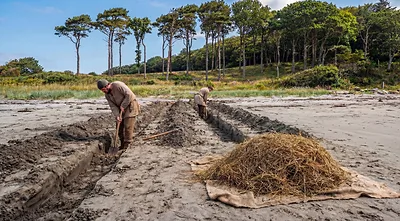
In the season's final War Room meeting, Rick, Marty, Craig, Dave Blankenship, Dan Blankenship, and Charles Barkhouse review the year's results. Dan counsels the team to take the winter to analyse the data without emotion before deciding whether and where to continue. The team agrees they have found sufficient proof of man-made activity deep in the Money Pit to justify returning, citing the pre-1700 wood, the metal plates, the Spanish galleon spike, and the French drain system at Smith's Cove as evidence that the original story is real. Rick declares victory for the season and calls for adjournment. Operations are suspended until the following summer, with the team confident that this has been their most productive year yet and that the answers they seek may be only feet from where they have been digging.