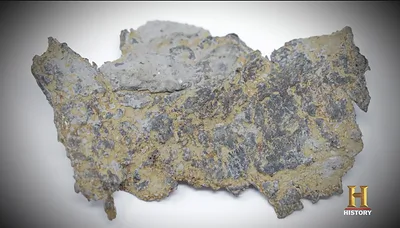
About This Artifact
Multiple recoveries of small metal fragments from boreholes drilled by Triton Alliance between 1969 and 1971 produced what searchers regarded as physical evidence of early human work at depths well below the bedrock surface. The campaign centred on Borehole 10, later designated 10X, sunk by Dan Blankenship in November 1969 some 180 feet northeast of the Money Pit. During clean-out of the casing, two handfuls of metal fragments came up from a depth thought to be 165 feet or above.
Sullivan's account records that high-pressure air injected into 10X blew out enough thin metal from 165 feet to fill both of a man's hands. The metal began oxidising within minutes of exposure to the outside air and turned so brittle it crumbled when touched. The Steel Company of Canada in Hamilton received samples for analysis. Metallurgist A. B. Dove reported in 1971 that case-hardened low-carbon steel from a recovered chain showed treatment that was archaic, with cleanliness indicating the possibility of Swedish steel, and that until 1747 the British Navy would not use English steels industrially. Wire samples were also low-carbon steel of similar character. Angular sections were folded wrought iron, in all probability produced prior to 1750.
A separate recovery occurred in Golder Borehole G201, sunk in late May 1970 about 100 feet north-northeast of 10X. Metal pieces embedded in an intact 1.5-inch diameter sample of sand from 84.5 to 86.5 feet were analysed by the Steel Company of Canada in November 1970 and described as friable fragments of wrought iron dating prior to 1800. Fader and Steele caution that downhole drag from advancing drill casings means recovered fragments may have originated from levels other than where they were retrieved.
Historical Context
Stelco Steel Company of Canada, "Review of Findings at Hole 10X" (1971), metallurgical analysis by A. B. Dove. Stelco report dated November 19, 1970 on Golder Borehole G201 metal pieces. Martin Pickford field reports for Triton Alliance (1970-1971), compiled by Les MacPhie. Joy Steele and Gordon Fader, Oak Island Mystery Solved, 2nd ed. (Halifax: Formac, 2018), Chapter 12. Randall Sullivan, The Curse of Oak Island (New York: Atlantic Monthly Press, 2018), account of 10X drilling and metal recovery. Field sketches and photographs courtesy of Les MacPhie, archived at the Beaton Institute, Cape Breton University.
Where It Was Found
Found at Borehole 10X and Golder Boreholes G201, G202, G203 (Lot 18 vicinity). Location: the original 1795 excavation shaft on Oak Island, Nova Scotia.