Construction of the 525-foot steel cofferdam at Smith's Cove continues as the Irving Equipment crew, led by Mike Jardine, drives the final interlocking steel sheets into the seabed. Rick Lagina and Dave Blankenship bring 95-year-old Dan Blankenship to the site for an inspection. Dan marvels at the scale of the operation, noting the 300-ton crane and the improvements over his own earth-filled cofferdam from the early 1970s, when a series of violent storms destroyed the structure before he could fully expose the U-shaped formation he had discovered. Rick reflects that Dan's decades of experience make him invaluable, and Dan observes the new cofferdam extends well beyond the U-shaped structure.
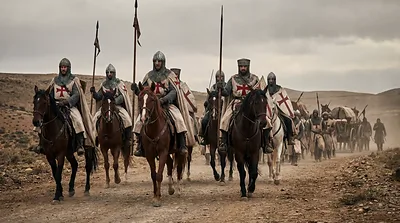
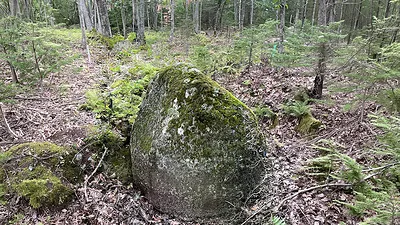
In the War Room, Judi Rudebusch, a former research partner of the late author Zena Halpern, introduces the team to researcher Gretchen Cornwall and modern-day Templar John Temple via video call. Jack Begley connects the call as Gretchen, author of "The Secret Dossier of a Knight Templar of the Sangreal," presents the theory that outlawed Templars fled to Nova Scotia after their persecution in 1307 through 1312, and that the Jolly Roger was originally a Templar emblem representing their patron saint, John the Baptist. She argues that Nolan's Cross, the megalithic boulder formation discovered by Fred Nolan in 1981, was placed by Templars as a literal key to the Money Pit. By scaling down the cross dimensions and overlaying them on the original shaft, a side chamber some 36 feet from the main shaft would be revealed. Charles Barkhouse notes the fundamental obstacle: the original shaft's precise location has been lost after more than two centuries of searcher activity.
Craig Tester, Charles, Gary Drayton, and geologist Terry Matheson oversee sonic drilling at the mega-bin area, roughly 600 feet northeast of the Money Pit, where seismic scanning had identified a large anomaly at approximately 50 feet and where Dan Blankenship reported finding tunnels and an impenetrable metal plate at 100 feet in 1973. Choice Drilling operator Brennan drives the core barrel through dense clay until, at 53 feet, the sample reveals a transition to loosely packed sand, which Terry concludes is the natural feature the seismic equipment detected rather than a man-made chamber. The drill continues deeper but strikes bedrock at 99.5 feet with no evidence of tunnels, voids, or metal obstruction. Rick acknowledges the disappointment but notes that eliminating the mega-bin target allows the team to redirect their resources.
The episode's most significant development comes when geochemist Tobias Skowronek of the German Mining Museum in Bochum presents his lead isotope analysis of the cross found at Smith's Cove. After comparing the data against his extensive database of ore bodies, Skowronek reports that the lead does not match any North American deposits and is inconsistent with European quarries exploited from the 15th century onward. Instead, the isotopes match medieval mining deposits in the Cévennes and Montagne Noire mountain ranges of Southern France, within roughly 20 miles of Rennes-le-Château, a village with strong Knights Templar connections dating to the 13th century. The finding places the lead as pre-15th century, from a deposit too small for industrial-scale exploitation.
The War Room erupts at the connection to Southern France. Marty recalls visiting Rennes-le-Château four years earlier and meeting modern-day Templar Grand Master Tobi Dobler, who asserted that Templars moved religious artifacts from France to Scotland and eventually to Oak Island. Gary Drayton calls the cross one of the most historic finds ever made in North America if it was deposited near the time it was manufactured. Marty, typically skeptical, concedes the lead isotope data represents hard evidence he cannot disregard. Doug Crowell and the team note that the cofferdam excavation, where the cross was originally found, has yet to begin.