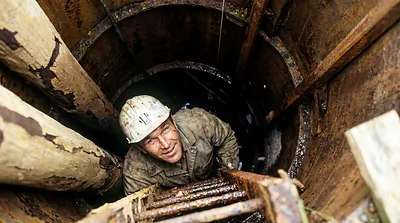
Rick Lagina continues clearing Borehole 10-X for the upcoming dive. Lowered into the shaft in a steel cage, he uses a blowtorch to cut away rusted metal casings and rotting timber that could injure the divers. The interior is in far worse condition than anticipated, with ladder sections heavier than expected and the corroded steel difficult to cut. Rick reflects on the irony of deconstructing the shaft that Dan and Dave Blankenship spent years building, tearing it apart in pursuit of the same answers they were seeking when they dug it more than 40 years ago.
In a War Room teleconference with Marty Lagina and Craig Tester in Traverse City, Michigan, the team reviews carbon dating results. A hardwood tree stump pulled from the swamp by diver Tony Sampson dates to between 1450 and 1640 AD, helping establish when the swamp was created and when treasure may have been buried. The two pieces of wood recovered from the Money Pit core sample, both the horizontal piece and the vertical post, date to between 1665 and 1900, an enormous range that leaves open the possibility that the Chappell vault is either a 17th-century treasure chamber or a 19th-century searcher tunnel. Craig notes that the 1665 date is old enough for some theories but does not align with the coconut fiber dating of 1260 to 1400 AD or other more ancient evidence. William Chappell's 1897 drilling is also discussed: at 171 feet, deeper than the vault itself, he struck what he described as an iron plate that his drill bit could not penetrate, raising the possibility of an even older structure below.
J. Hutton Pulitzer returns to the island to help reinforce the diving platform and introduces the dive team he has recruited. Lead diver Dan Misiaszek, known as Frog, is a former US Army infantryman and police officer who has completed technical dives in some of the most dangerous environments in the world, from open water to underwater caves. Dave Blankenship recounts the harrowing history of 10-X: in 1976, while Dan Blankenship was being lowered 150 feet down the original 27-inch shaft in a saddle on an electric hoist, pressure from one of the suspected flood tunnels caused the borehole to begin collapsing above his head. Dave, operating the hoist at the surface, heard his father's desperate calls and pulled him above the collapse zone with just seconds to spare. A 1993 dive attempt also nearly ended in tragedy when a hired diver ascended too quickly from 235 feet and suffered serious decompression sickness, requiring multiple treatments in a recompression chamber.
With the platform complete and all safety protocols in place, the team prepares for the historic descent. Dan Blankenship, now in his nineties, tells the team he believes two chests and one body lie at the bottom. Rick volunteers to ride the steel cage down with diver Cathy Mashuk, known as Flash, to ensure she enters the water safely. The cage is lowered until both Rick and Cathy are fully submerged in water measuring just 41 degrees Fahrenheit. Cathy's tanks snag on a bar inside the shaft, and several tense minutes pass as Rick, up to his neck in ice-cold water, works to free her equipment and guide her out of the cage and into the shaft.
Once both divers are in the water, communication and video lines are activated, giving the team their first real-time view inside 10-X. For the first time in nearly 40 years, trained divers with modern cameras are descending toward the cavern where Dan insists he saw wooden beams, antique tools, treasure chests, and human remains. As the season draws to a close, the team stands on the brink of what could be the most significant discovery in the history of Oak Island.