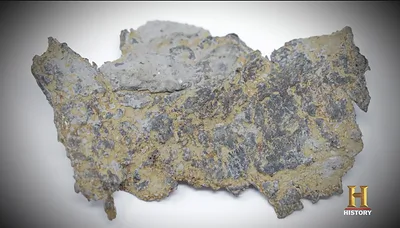
About This Artifact
Pieces of leather identified as a boot heel and sole were recovered from the spoils of borehole 8-B in the Money Pit area during Season 8. The borehole was located just ten feet from where wood previously recovered from an underground tunnel had been carbon dated to 1706. Alex Lagina, Peter Fornetti, Dan Henskee, and Michael John identified the leather fragments during the wash-table sorting process.
Charles Barkhouse and Doug Crowell transported the leather to the Dawson Print Shop in Halifax, where rare manuscript conservator and leather expert Joe Landry examined them. Landry identified the material as thick, high-quality leather with fine stitching and folded edges, characteristics of boots made for a wealthy customer rather than a common labourer. He suggested the boots may have belonged to a sea captain or someone of similar social standing. Carbon dating subsequently placed the leather between 1492 and 1662 with ninety-five percent confidence, predating the discovery of the Money Pit by more than 140 years.
Marty Lagina observed that leather dating to 1492 would be significant anywhere in North America, and finding it directly in the Money Pit area represented a major development. The carbon date range spans from the era of Columbus through to the mid-seventeenth century, overlapping with multiple proposed timelines for the original construction of the Money Pit, including the Portuguese, Spanish, French, and Templar theories. The combination of the leather's age, its high-end manufacture, and its recovery from near a tunnel dated to 1706 pointed to the presence of someone of means during the original deposit rather than a later searcher. Gary Drayton described it as medieval, and the team concluded the artefact almost certainly belonged to an individual present during the original activity on the island.
Historical Context
Lagina team
Where It Was Found
Found at Borehole 8-B spoils, Money Pit. Location: the original 1795 excavation shaft on Oak Island, Nova Scotia.