While the Irving Equipment crew continues advancing the H-8 shaft toward its 150-foot target depth at the Money Pit, Rick Lagina travels to France with nephews Alex Lagina and Peter Fornetti. On the train from Paris to Charente, professional researcher and translator Nichola Lewis briefs the group on her findings linking the mysterious HO Stone from Oak Island to Templar imagery. Lewis has identified wall paintings in two Templar chapels near Charente depicting crosses with pellets in the four quadrants, virtually identical to the HO Stone's central motif. She proposes the stone's letters are ancient Greek: the H representing Eta and the O representing Theos, meaning God, forming a Christogram that dates to the fourth century and was later adopted by the Knights Templar through the Chi-Rho cross tradition.
At Chateau de la Rochefoucauld, Sonia Matossian, representing the 42nd of 43 generations of the Rochefoucauld family, welcomes Rick and his nephews to the castle built on Foucauld's Rock in the year 980. Rick shows her the Zena Halpern map bearing the Rochefoucauld name and asks about Templar connections. Matossian confirms the family participated in the Crusades and would certainly have encountered the Templars, though she has no direct records of formal ties. She and Nichola Lewis examine the Old French writing on the map and correct a critical translation error: the phrase previously rendered as a little drink from Neustria in fact reads a little towards the west, a significantly different meaning that strengthens the map's potential as a directional document. Exploration of the caves beneath the castle reveals no carvings, as 18th-century leather tanners diverted the river under the foundation and washed the surfaces clean.
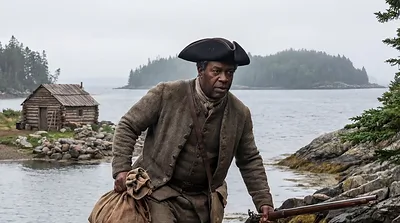
On Oak Island, Marty Lagina, Dave Blankenship, Gary Drayton, and archaeologist Laird Niven conduct a permitted excavation on Lot 24, one of several properties once owned by former slave Samuel Ball. Laird uncovers a concentration of deliberately placed stones that he interprets as a possible floor rather than a natural glacial deposit. The team screens the spoils and recovers a fragment of Staffordshire slipware pottery that Laird dates to the mid-18th century, around the 1770s, making it the earliest artifact found on the lot. The foundation's elevated position overlooking the mainland suggests it may have served as a lookout post rather than a dwelling.
Rick, Alex, and Peter then travel to the village of Domme, where Templar expert Jerry Glover leads them through the 14th-century prison where at least 70 Knights Templar were held after their arrest on Friday the 13th, 1307. The prisoners carved symbols into the stone walls using their teeth and fingernails, leaving behind crosses, depictions of the Virgin Mary, and a geometric design Glover identifies as the Kabbalistic Tree of Life. Rick connects this carving to Nolan's Cross on Oak Island, which researchers have long theorized represents the same symbol. Glover also points out the distinctive Domme cross with branching plant-like forms, a design he says exists nowhere else, and a carving of the Holy Grail whose shape Rick and Alex note resembles the Rochefoucauld family coat of arms. Most significantly, crosses with four pellets in their quadrants match the HO Stone almost exactly.
Back in the War Room, Rick and Alex present their findings to Marty, showing side-by-side comparisons of the Domme carvings and the HO Stone. Marty concedes the pellet crosses are not merely similar but identical, though he questions what direct connection the carvings prove to Oak Island. Rick argues the evidence links the Templars to the Tree of Life, the Tree of Life to Nolan's Cross, and the entire chain back to the swamp and the Money Pit. He reaffirms that the search remains as much an information hunt as a treasure hunt, and the team agrees to press forward with renewed focus on finding the one irrefutable piece of evidence.