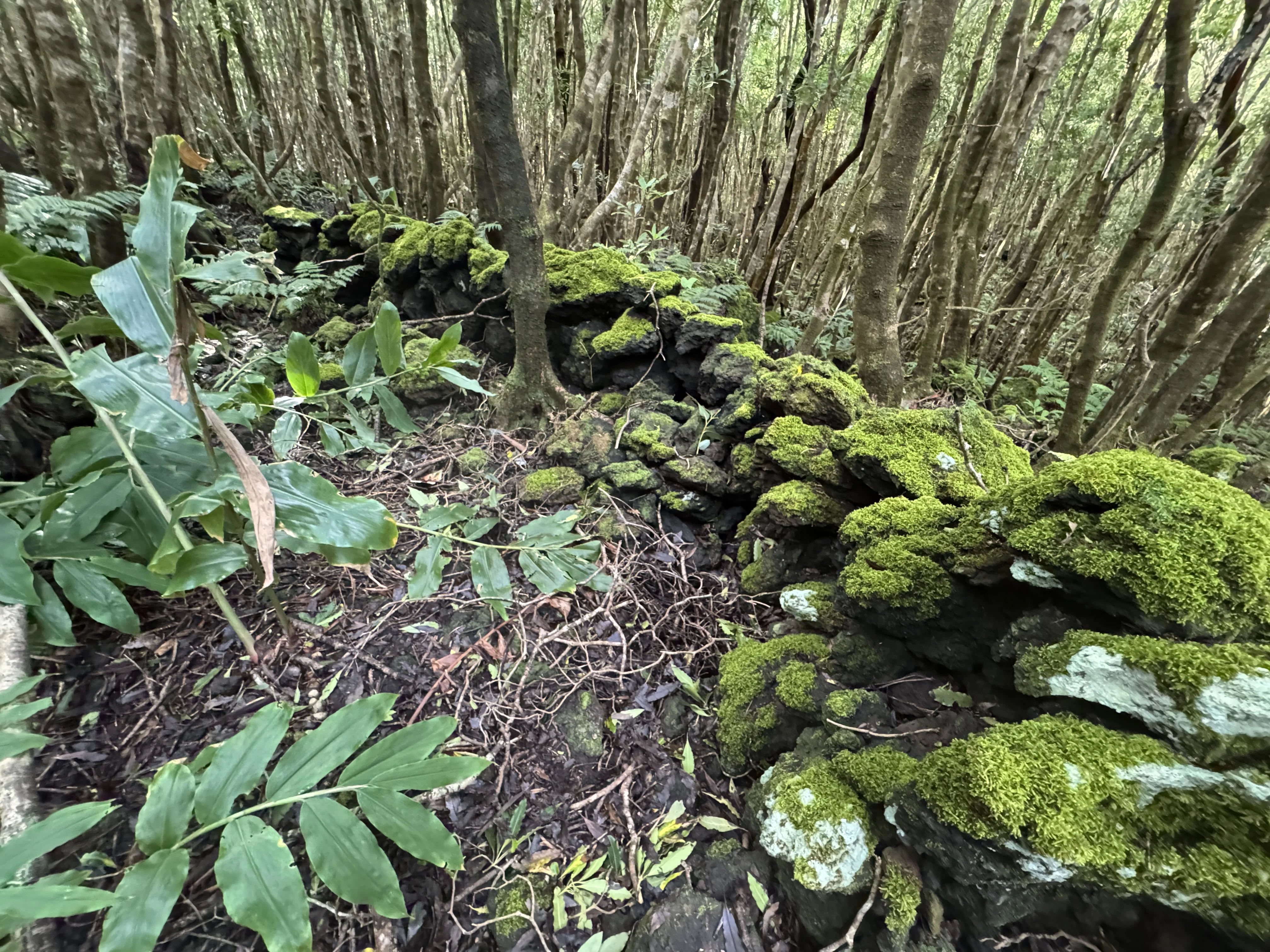
The dry-stone constructions at Serreta share a signature technique with the Lot 26 wall on Oak Island: large retaining boulders on the outer edges and a core of smaller rubble held between them, at comparable wall widths. Available carbon dates for similar Azorean walls fall around 1470 to 1475, close to the working timeline for Lot 26. If any…
A large group of stone constructions covering two to three square kilometres in the forest at the northwest limits of Serreta on the island of Terceira in the Azores. The site appears in no cadastral record and has been the subject of one published academic notice, a single page in a 2012 survey paper. No excavation has been conducted and no dating has been attempted.
About This Site
Within the forest at the northwest limits of Serreta, on the western tip of Terceira in the Azores, lies a field of stone constructions covering between two and three square kilometres, perhaps more. The terrain is sterile, the canopy is dense enough to impair any clear view from above, and rough tracks of unknown origin cross the entire area. The forest is mature, with trunks and roots grown through several of the walls. Many of the constructions are rectangular in plan. Some have no openings or passages between them. The amount of stone involved, and the volume of work required to move and place it, is very substantial.
The site does not appear in any civil cadastral record, in any historical document, on any official map, or in the holdings of the parish or municipal offices of Angra do Heroísmo. The only modern association is a brief, abandoned attempt by one or two couples to start a vineyard at the southern edge, where two or three organised constructions can be plausibly attributed to that effort. Immediately before and after the vineyard area, the older ruins continue at the same density and in the same unfamiliar pattern.
The site was first published in December 2012 by Antonieta Costa, PhD researcher at CITCEM, University of Porto, in a survey paper titled Terceira Island as a "megalithic station". Costa lists Serreta as the first of four anomalous archaeological areas on Terceira, alongside the Mount Brasil hypogea, the Grota do Medo complex outside Angra, and the cart ruts of S. Brás. Her account of Serreta runs to a single page. No follow-up academic work has been published. No excavation has been conducted. No samples have been submitted for radiocarbon dating. The Regional Government of the Azores has not commissioned any assessment, and the broader debate over pre-Portuguese presence on Terceira, which has focused on Mount Brasil and Grota do Medo, has bypassed Serreta entirely.
The historical context narrows the question without answering it. Serreta is the part of Terceira that was settled latest. While the rest of the southwest coast was occupied by Portuguese settlers around 1510, the territory of Serreta was not generally settled until the middle of the 17th century, and the parish only became administratively independent from neighbouring Doze Ribeiras in 1862. The poor pumice soils, altitude and exposure made the area marginal, and a hermit priest is recorded as the first sustained resident. The Portuguese settlers who eventually moved into the area appear to have left no record of the constructions in the forest above them, despite the scale of the site and the difficulty of missing it.
What can be established with confidence is limited. A substantial field of stone constructions exists in the forest at the northwest limits of Serreta. It does not appear in any official record. The only published academic notice is a single page from 2012. The local population, on the evidence of the cadastral absence, did not build it and does not have a tradition explaining it. What cannot be established, in the absence of dating evidence or excavation, is who built the constructions, when, or for what purpose. The site remains, by every available measure, unexamined.
Connection to Oak Island
The dry-stone constructions at Serreta share a signature technique with the Lot 26 wall on Oak Island: large retaining boulders on the outer edges and a core of smaller rubble held between them, at comparable wall widths. Available carbon dates for similar Azorean walls fall around 1470 to 1475, close to the working timeline for Lot 26. If any part of Serreta belongs to a period earlier than the official Portuguese settlement of the island, it places a comparable building culture on a direct North Atlantic line between the Iberian peninsula and Nova Scotia, consistent with the route the team has been tracing through the rest of the Terceira evidence.
Fieldwork Notes
Visited in S13E23 (April 2026) by Rick Lagina, Alex Lagina, Doug Crowell, Peter Fornetti, Corjan Mol, and Emiliano Aversano, guided by historian Francisco Nogueira. The team moved through a section of the stone field, opened up several walls visually, and compared each one to reference images of the Lot 26 wall. Observations focused on construction geometry: large edge boulders, small rubble infill, and wall widths close to those recorded on Oak Island. No excavation was undertaken and no samples were taken. The visit registered the site photographically and in direct comparison with Lot 26, to support continuing study of the wider Portuguese-Azorean dry-stone tradition.
Gallery