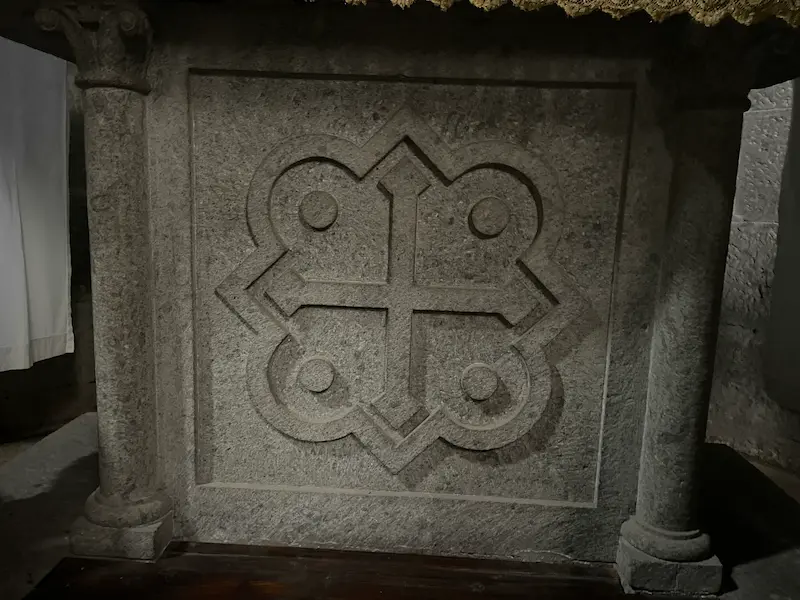
In Season 10, Rick Lagina, Doug Crowell, Alex Lagina, Peter Fornetti, and Corjan Mol visited the church guided by Templar investigator Gianluca Di Prosper and translator Emiliano Sacchetti. Inside, Peter Fornetti spotted a symbol matching one found on the H/O stone from Oak Island. Gianluca explained that four-dot crosses mark special places…
Medieval church in Viterbo, built in 1080, containing carved Templar symbols including four-dot crosses and Latin inscriptions that Alex Lagina proposed could be decoded as "Here Templar Gold," matching symbols on the Oak Island H/O stone.
About This Site
The Church of Santa Maria Nuova is a Romanesque church in Viterbo, central Italy, built in 1080 during a period when the city served as a centre of papal and religious authority. The church predates the formal founding of the Knights Templar in 1119, but its walls and pillars bear carved symbols and inscriptions that researchers have connected to the order's later presence in the region. The church is situated in a city that served as temporary headquarters for Pope Alexander IV in the 13th century, and its medieval fabric has been preserved with relatively few later alterations, making it a valuable site for studying early medieval religious and military-order symbolism. Templar investigator Gianluca Di Prosper, who has spent more than two decades researching medieval activity in the Viterbo region, considers the church a key site in tracing Templar movements through central Italy.
Connection to Oak Island
In Season 10, Rick Lagina, Doug Crowell, Alex Lagina, Peter Fornetti, and Corjan Mol visited the church guided by Templar investigator Gianluca Di Prosper and translator Emiliano Sacchetti. Inside, Peter Fornetti spotted a symbol matching one found on the H/O stone from Oak Island. Gianluca explained that four-dot crosses mark special places associated with the Templars, the Holy Grail, or the Holy Shroud.
As the group continued through the church, Alex found the Latin letters HIC carved on a pillar, which Emiliano translated as "here." Nearby they noticed a letter A that Gianluca identified as a compass reference, and a square symbol he described as more Masonic in character but anomalous given the church's 11th-century construction date. Alex photographed the carving and demonstrated how, with a few pen strokes, the I could become a cross with four dots and the C a circle with a dot at its centre, recreating the symbols found on the H/O stone. The resulting decoded message, Alex proposed, reads "Here Templar Gold." The discovery suggested that the H/O stone from Oak Island may contain a cypher based on a symbolic tradition rooted in medieval Italian church architecture.
Fieldwork Notes
Visited during Season 10 by Rick Lagina, Doug Crowell, Alex Lagina, Peter Fornetti, and Corjan Mol, guided by Gianluca Di Prosper and Emiliano Sacchetti. The team documented four-dot crosses, the HIC Latin inscription, compass and square symbols, and Alex's proposed decoding of the H/O stone as "Here Templar Gold."
Gallery